And keep notes on your tiny visitors, if you like, so you can verify for yourself that this is a normal, annual process.When should I take down my feeder?All good things, as they say, must come to an end. Unless you live in California, that usually includes hummingbirds, at least until next spring. Depending on where you live, the fall departure for the southward migration typically occurs between July and November.Hummingbirds migrate in response to hormonal changes, which are triggered by decreasing length of daylight; nothing you can do will make them stay too long, so it’s not necessary to stop feeding them to force them to go south. On the contrary: they will need to fatten up to nearly double normal body weight to survive the journey, and thus appreciate your feeder more than ever up until literally the last minute before they depart.It is recommend continuing to maintain at least one feeder for a week or two after seeing your last hummer of the season. Sometimes an individual bird can’t migrate on schedule, due to illness or injury: these late migrants in particular will appreciate having a reliable source of food at a time when few natural flowers are still in bloom.
|
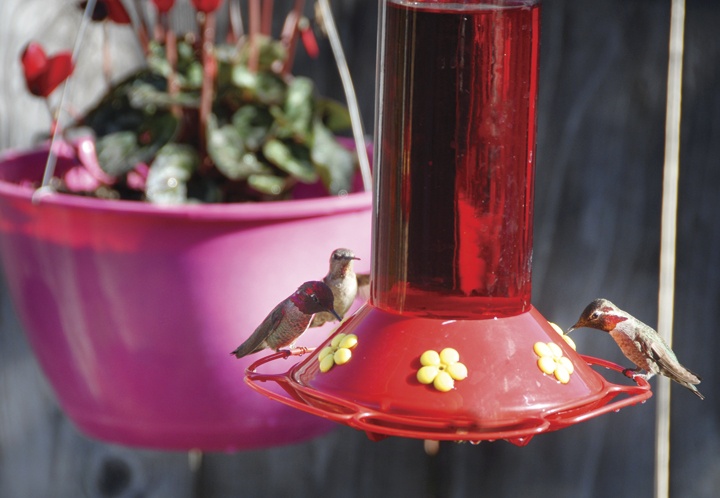
These hummingbirds feed during one of the coldest days in Santa Paula. This feeder and five others have been feeding 20 to 25 birds throughout the winter months. It is very important to keep feeders clean and be stocked with fresh feed. Hummingbirds come and go during the winter months. (Photo by Don Johnson) |
Hummingbirds still around Santa Paula
January 14, 2009
Santa Paula News
Hummingbird Plumage and Colors
The brilliant, iridescent colors of hummingbird plumage are caused by the refraction of incident light by the structures of certain feathers. Like any diffraction grating or prism, these structures split light into its component colors, and only certain frequencies are refracted back to the viewer. The apparent color of any particular part of a feather depends upon the distance between the microscopic ridges in its gridlike structure. The resulting colors are much more vivid and iridescent than those of birds with only pigmented feathers. Not all hummer colors are due to feather structure, however; the duller, rusty browns of Allen’s and Rufous Hummingbirds are the result of pigmentation. Iridescent hummingbird colors actually result from a combination of refraction and pigmentation, since the diffraction structures themselves are made of melanin, a pigment.Where did my hummers go?You watched the migration maps and hung your feeder in time to attract the first migrants. You kept the feeder clean and the syrup fresh, and were rewarded by lots of visits from migrants, then the activity settled down to regular appearances by the resident birds. Pretty cool hobby, eh? Then, perhaps in early May (depending on your latitude)...NO MORE HUMMERS! Where’d they all go? This didn’t happen last year! Or did it?Welcome to the nesting season. Ruby-throats in particular, but similar principles probably apply to most other species. Shortly after arriving, the females establish a nesting territory. Ruby-throats prefer secluded wetlands for nesting, if available, and proximity to your feeder is not an issue; in fact, females don’t like to build nests in a male’s feeding territory, and your feeder is probably part of one. Visits to distant feeders take too much time away from the eggs. When the chicks hatch, they need protein to grow, not sugar, so their mother spends most of her time catching small insects and spiders for them.During this period, you still see a male or two at feeders, but typically only early or late in the day. Once their breeding duties are over, males tend to abandon territories and forage more widely to fatten up for migration.After the chicks fledge (leave the nest), expect the number of hummers at your feeder to be double what it was before the “disappearance.” As summer progresses, there will be fewer natural hummingbird food sources available; feeders can have a real positive impact on the number of birds that survive, so please keep them clean and fresh.