|
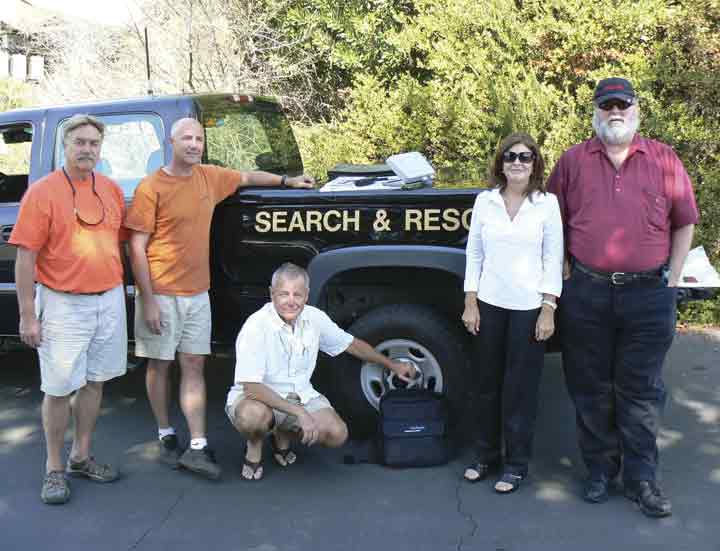
Upper Ojai Search and Rescue volunteers (left to right) Paul Belgum, Andy Van Sciver and Roger Mcdivitt were on hand to accept a donation of important communication equipment from Vizada’s Karen Brooks and Vizada General Manager Tom Hunter. |
Ojai Search & Rescue: Vizada comes to the aid of emergency responders
September 16, 2011
By Peggy Kelly
Santa Paula News
The Upper Ojai Search & Rescue team (SAR) will find it easier to do their job of helping those in distress, due to a donation of a Wideye Saber 1 terminal to the unit. The unit was donated by Vizada, the leading independent provider of global satellite-based mobility services, which offers mobile and fixed connectivity services from multiple satellite networks and has a teleport based in Santa Paula.
According to Andy Van Sciver of SAR, the “Wideye Saber 1 is a satellite terminal that enables our team to have voice and data connectivity anywhere we don’t have cellular service,” which includes much concentrated forest and canyon areas.
The Wideye “Is a highly portable terminal providing high-speed data and voice in remote locations,” especially important for the SAR team, as “We sometimes operate outside the ‘cellular bubble’ of society,” such as the Los Padres National Forest, areas of Wheeler Gorge, Rose Valley, Pine Mountain and Lockwood Valley as well as areas of Piru. Often when responding to such areas, “We don’t have radio or cellular coverage to communicate back to dispatch,” but, noted Van Sciver, “the Wideye enable us to stay connected, keeping tabs on the weather and at the same time making phone calls for more resources.”
Even in the event of significant disaster when the phone lines become compromised, “We are connected and can communicate to the outside world from our mobile command post thru the Wideye terminal.” The terminal allows access to important data required by emergency responders such as the current weather and Google Earth.
Expanded technology to access the latter is especially welcome as, Van Sciver said, “More recently we have been using iPads on our SAR calls to get a bird’s eye view from Google Earth. This provides us a quick snapshot of the terrain in addition to the topo maps we carry. We would not have access to this type of information without a cellular link and now we can access it through a satellite link.”
Although the VCSD provides transportation and basics to the volunteer group, it relies heavily on fundraising to purchase much of its own equipment, making the donation especially generous and thoughtful, said Van Sciver.
Vizada Operations Manager Tom Hunter said the system, which has four locations around the globe, “pretty much” covers the entire world. He said the company is pleased it could provide service for emergency responders closer to home.
The donation resulted from CPR and other training Van Sciver was conducting for the facility’s 14 or so employees: “I gave him the nickel tour,” and Hunter said Van Sciver told him of SAR’s need of communicating outside the cell phone range. “I thought we might be able to do something about that,” and after corporate approval was garnered Van Sciver worked with the county to accept the terminal.
Hunter said the county is paying for the cost efficient airtime for the unit: “We have them on a plan that’s like a rollover plan for a cell phone.” Most important is, “As long as SAR has a clear shot to the southern sky they can communicate.”
Vizada and its Santa Paula Land Earth Station - built in 1975 - have a long history of extensive experience with VSAT C-band links and other areas of propagation. Santa Paula was built in 1975 by Comsat and has used C-band uplink for more than 30 years to provide two-way satellite communications. Over the years services have expanded to include mobile satellite and other services to fixed sites and maritime platforms.
Since 2002, Santa Paula and its sister Comsat Land Earth Station (LES) in Southbury, Connecticut have been part of the former Telenor Satellite Services global satellite services network. Now known as Vizada, its customers include the governments of the United States and numerous other countries, United Nations agencies, and large international corporations.
Santa Paula’s experience over the years includes providing feeder-links for the Olympic Games in Los Angeles in 1984 and Seoul in 1992 and various services, circuits and links circuits between the U.S. and Australia, for the Valdez oil spill, U.S. Coast Guard and Federal Aviation Administration among others.
Santa Paula’s staff is highly experienced in not only installation and maintenance of antennas and supporting equipment and operating C-band uplinks, but also in commissioning and servicing remote VSAT sites. In its capacity as one of the Network Control Centers in the Vizada global maritime VSAT network, Santa Paula serves vessels that are constantly moving between the coverage provided by Santa Paula and other Vizada LESs, constantly interacting with the satellite operators and personnel operating the VSATs to commission and/or decommission the remote sites.