|
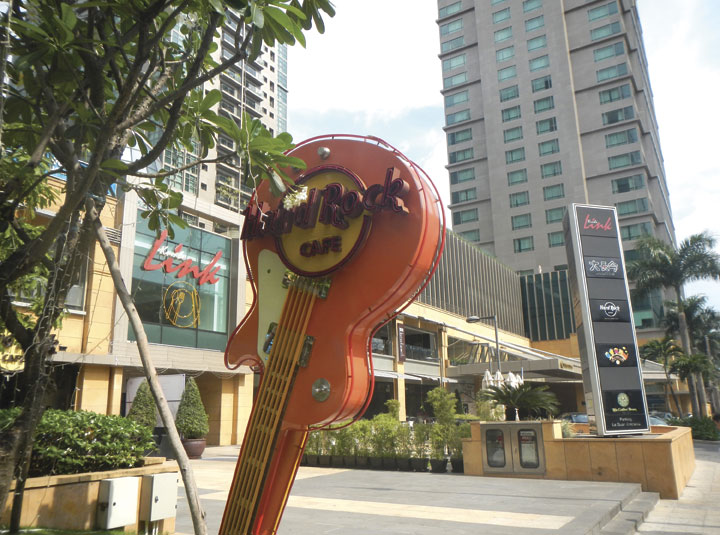
Saigon is a modern large city in South Vietnam. The city was renamed Ho Chi Minh City after the war but almost all South Vietnamese call it Saigon. The InterContinental Hotel is a large hotel with a Hard Rock Cafe, Coffee Bean & Tea Leaf and a nice shopping center. Several modern shopping malls were within walking distance of the InterContinental. |
South Vietnam Today
February 01, 2013
By Don Johnson
Santa Paula News
Debbie and I went to dinner at Quan Ngon Restaurant. The meal was excellent and the entire meal cost $12 or $40,000 VND. We weren’t sure at first; however, the restaurant was highly recommended and it turned out to be excellent.
We ordered a bowl of noodle soup and probably should have stopped at that point because it was the largest bowl of soup I have ever seen. Along with the soup we ordered spring rolls. Along with that I ordered a chicken dinner and Debbie ordered a pork dinner. Oh I forgot, three beers.
What made it a very interesting was the restaurant kitchen was basically outdoors. There were large pots of noodle soup and rice that had been precooked for that night’s dinner quests.
The restaurant was very busy, especially with locals. I have always said if the locals patronize a restaurant the odds are pretty good that it will be excellent.
Following dinner we made our way back to our hotel. We stayed at the 5 Star InterContinental Hotel. Excellent facility with excellent service.
The next morning we began our tour with Avalon Waterways. Our entire tour group was 32 people. Our group was certainly international. In the group were four Canadians, two Australians, two from the Netherlands. Also, along with myself we had five other Vietnam veterans.
We met in the lobby with our Cruise Director Mark Nicholls and our local Vietnamese tour guide Long. The first day was to be a walking tour; however, a bus was waiting for us. The bus took us about two blocks for the first stop. I was trying to figure out why we even got on the bus. It came down to the fact it was about 90 degrees and 80 percent humidity.
The bus stopped at the famous Rex Hotel. The hotel was constructed in 1927 for French businessman Bainier during France’s colonial rule of Vietnam. The building started out as a two-story auto dealership and garage complex, called “Bainier Auto Hall.” The building showcased Citroën and other European cars. From 1959 to 1975, Mr. and Mrs. Ung Thi renovated the building into the 100-room “Rex Complex” hotel, which featured three cinemas, a cafeteria, a dance hall and a library.
The first guests in the Rex came in December 1961, while it was still in its final construction phase. They were 400 U.S. Army soldiers, 200 each of the 57th Transportation Company from Fort Lewis, Tacoma, Washington, and of the 8th Transportation Company from Fort Bragg, North Carolina. They were the first company-strength units to arrive in Saigon, each unit with 20 H-21 twin rotor “Shawnee” helicopters, on the USS Core, on December 11, 1961. They were billeted at the Rex for a week or so while their tents were being set up at Tan Son Nhut, Saigon, for the 57th and in Quy Nhon for the 8th.
The hotel was made famous during the Vietnam War when it was hosting the American military command’s daily conference, derisively named “The Five O’Clock Follies” by cynical journalists who’d find the optimism of the American officers to be misguided. Its rooftop bar was a well-known hangout spot for military officials and war correspondents.
Following our stop at the Rex Hotel we walked over to the Opera House, where live music was being played on the steps. Each Saturday for four hours music is played to help bring culture to the people of Saigon, and the music is played by students. Thousands of motorbikes were driving by the Opera House and many just stopped in the street to listen.
We then stopped at the Notre Dame Church. What was interesting about this stop, a dozen or so wedding couples were having their wedding pictures taken. As a custom, two to three weeks before the wedding couples show up at the church grounds for photos. The cost for photos is between $200 and $300 U.S. dollars.
Following a quick stop at the post office we went on to the Reunification Palace, which is now a museum. Part of the tour took us to the basement that was used as the war room during the Vietnam War. This room was used by high officials of the South Vietnamese government conducting war operations.
Following the tour of the Reunification Palace, our group stopped at the War Remnants Museum. On entering the museum grounds, we saw on display captured military equipment, planes, helicopters, and artillery pieces. It was at this point our tour guide reminded us the museum was from the Vietnamese side of the war and in some cases the photos would be disturbing.
The museum was three stories, with walls filled with photos. Many photos on display were clippings from U.S. magazine and newspapers. All the photos depicted what the Vietnam government thought were U.S. military atrocities. These photos were displayed so local Vietnamese who visited the museum would believe that the U.S. military was bad.
The tour guides were correct; the museum was very one-sided and really didn’t tell the whole Vietnam War story. I fully expected that everything would be one-sided, and that was the case.
The next article will cover the Cu Chi Tunnels, where up to 15,000 soldiers lived and fought during the Vietnam War. The construction of the tunnels was very interesting. The tunnels started at the end of the Ho Chi Minh Trail and extended almost to Saigon.